Tuesday, October 17, 2017

Two new articles: About universities and routines


Would you let an accounting firm determine how to run your local institutions of higher learning? My latest opinion piece for the CBC is about how Manitoba's government is relying on a report written by KPMG to make big changes at Manitoba's universities. 
KPMG's value-for-money report fails Manitoba universities 

Another article ran recently both in Winnipeg and Vancouver:  It's how we use religious ritual and routine to cope during times of sadness.  It's called:
Jewish routines help us cope

On the home front, we've been busy with grandparents visiting from the US, grade 1, and adjusting to life as a one-dog household.  It's been busy.  Last night though, as I was helping one kid in the shower, he said earnestly, with great concern:

"You work really hard, Mommy.  So hard!"  I asked what it was he thought I was doing... I expected a long list of things like 'making lunches and dinners for us, doing laundry, walking the dog, etc' --things six year olds can see their Mommy doing.  Instead, he said:

"Well, you write one long book every day!" 

(I was very flattered, but tried to explain that a good week might include perhaps two essays, and/or a knitting design...lately, we've been so busy that I have hardly managed that.)  So, now I have something to aim towards.  One long book a day. :)

Labels: , , , , , , , ,

Thursday, October 20, 2016

Priorities

I planned to write lots about slow fashion in October, but we took a big family trip east to see relatives in NYC and Virginia (near DC) and we only got home yesterday. (Priorities here: family travels overruled all blog posts and computer time)

All went smoothly, and I think our twins mostly had a great time.  ...We had one 'throw up on Mommy on the airplane incident' but luckily, I had a change of clothes for everybody with me.  You know, par for the course when travelling with a couple of five year olds...

So, here are a few things to catch up:
Here's my latest piece on the CBC, which ran while we were travelling.  It is (surprise!) about priorities...educational ones.  How do we decide which students get priority?  Why do some misdeeds related to stealing intellectual property get seriously penalized while others are ignored?

International students pay more, get less at University of Manitoba

Also a matter of priorities...how do you know when to salvage something, how to mend it, and when to give up?

This is a mending job I did recently on a beloved quilt.  It belongs to one of my twins, it was handmade for him and has his name quilted right into it!  However, some of the stitching came out.  So, I made a very obvious repair.  I used matching embroidery floss and stitched it a bit like a crazy quilt, so that it was clear what I was doing.  I knew I couldn't make the repair invisibly, so instead, I fixed it like I meant it--in the tradition of meaningful mending that makes beloved textiles last a long time.

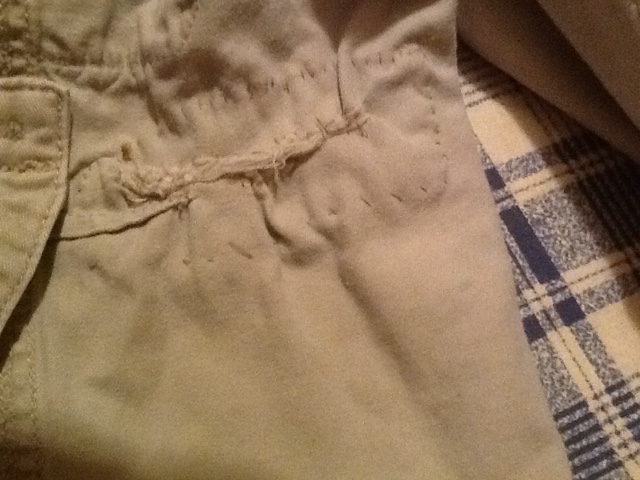
By contrast, I've developed a "two time and you're out" method when it comes to kids' pants.  I started by using cloth wipes left over from our cloth diapering days.  These are clean bits of well-used fabric, I hemmed and stitched them across knees as necessary.
Here is the backside of the pair of pants...as you can see, the stitching is not fancy.

Then, as the patches loosened, I went with iron-on patches on the back and front to keep the patch in place longer.  The patches are random; I bought a big bag of them, so I don't always choose a perfect match.  (at this point though, the priority is to keep the pants in circulation, so I don't focus on high fashion!)

After a few more wearings, this may or may not last..we may have to re-use this in the rag bag soon.  While visiting my family, my dad kindly did a third mending/repair job on two pairs of trousers that were worn hard and re-torn while playing at playgrounds.  We have a history of fixing things when they break, and having help on this was really a nice respite!  (This trip was a tour of living rooms, backyards, playgrounds, gardens, and a synagogue, for the most part; no major site-seeing despite the big city locations.)

The thing that I focus on when it comes to Slow Fashion (or how educational institutions work) is this:  What are one's priorities?  What is most important here?  Do we need to waste time or money unnecessarily?  How can we put people's needs first? Can we optimize conditions to re-use, recycle, or learn to make good use of new material to meet the needs of both people and the environment?

Those needs can be basic (food, water, housing) or a little more advanced (higher education tuition, registration, etc.) but it all comes to how we prioritize.  We need to use our ethical and moral values in the mix.  Let's not throw things out unnecessarily- but people's needs (and the environment) come first in the equation to maximize long usage of things into the future.  At least, that's how I hope it works in my house.  What do you hope for?

Labels: , , , , , , , , , , , ,

Tuesday, December 14, 2010

knowing smart people

Last year, the professor wandered across the university campus to meet with a Biomedical Engineering professor to talk about a collaborative grant proposal. They hit it off and became friends. This friend invited us to his house for a Sunday night discussion group. Originally, we based our discussions on college courses on DVD. We'd watch a lecture and then we'd discuss it. Invariably, one of us knew more than the introductory lecture. Others learned the material for the first time. This was all pretty interesting.

As time passed, we found we didn't need to start with someone else's lecture. Someone would come in with a short video clip or an idea, and we'd be off to the races, thick in discussion. Since then, things have blossomed. We make world-cuisine potluck meals (bring whatever you feel like, while respecting people's dietary issues) and we enjoy hanging out. In the summer time, we rotated houses and went to outdoor concerts. In the fall, a few folks went off to watch the bird migrations together.

Although most of us have some academic affiliation, we try not to get bogged down in "shop" talk. We are so different in some ways that conversation is inevitable. Our ages range from the mid-30s to mid-60s. The people in the group were born all over the world: Iran, Australia, Egypt, Canada, US, etc. Our religious backgrounds are really different, too. This all makes for rich conversation.

The tendency, as we get older, is to get comfortable in our peer groups. Maybe people hang out with family, friends with common interests, or people from their religious community. These habits tend to keep us from meeting amazing people who might not be just like us. For some, it's just hard to get up off the couch to try something new. The chance for intellectual growth is so great when we push ourselves to reach beyond those usual circles.

Today I was proud to know some of these people. This article about their important Alzheimer's research came out in the local paper. The researchers (my friends) were interviewed on TV news as well. In big ways, some of our friends are making a difference in the world. In small ways, we're helping each other move furniture, cope with job issues, or sharing recipes.

I don't think I could underestimate how it feels to know such clever, intellectually curious people. It's amazing...and, although I often bring my knitting on Sunday nights, sometimes I am just too immersed in stimulating conversation to knit as well. Now, that's saying something.

So, did you know that intellectual growth and activities (like knitting) help prevent Alzheimer's? What are you doing to keep mentally active?

Labels: , , , ,

  • Check out my website here: www.joanneseiff.com
  • Sheep to Shawl
  • Dances with Wool
  • Carpe Diem!
  • Knitting Along the River
  • Getting Stitched on the Farm
  • Modeknit/Knitting Heretic
  • Pleasant & Delightful
  • Catena
  • Independent Stitch
  • Rosemary-go-round
  • Spin Dye Knit
  • Kentucky Arts Council
    In 2007, Joanne Seiff was awarded an Al Smith Fellowship in recognition of artistic excellence for professional artists in Kentucky through the Kentucky Arts Council, a state agency in the Commerce Cabinet, supported by state tax dollars and federal funding from the National Endowment for the Arts, which believes that a great nation deserves great art.

    Powered by Blogger