Wednesday, July 28, 2021

Recalibrating

I recently had an article run that explained more about where I've been.  As the pandemic has been a constant, (nothing's back to "normal" for us yet)  I've worked and written at night when I can, but there's been a lot of time spent on other things.  Here is a link to the article: Recalibrating our life route 
This summer is another freeform one, where twins spend a lot of time on creative play in the yard, reading, making stuff and even doing a little learning...with outings to pick berries, swim at a lake for a day trip, etc. I mostly have stayed home with Sadie the dog while the professor does the out of town offerings.  I seem to be Mom in charge of playgrounds, farmer's market, wading pools, and long dog walks.
I've done some spinning, knitting, and lots of sewing....made my own version of MC Hammer pants...and even a brand new bag, with zippers... for taking care of business on those dog walks.
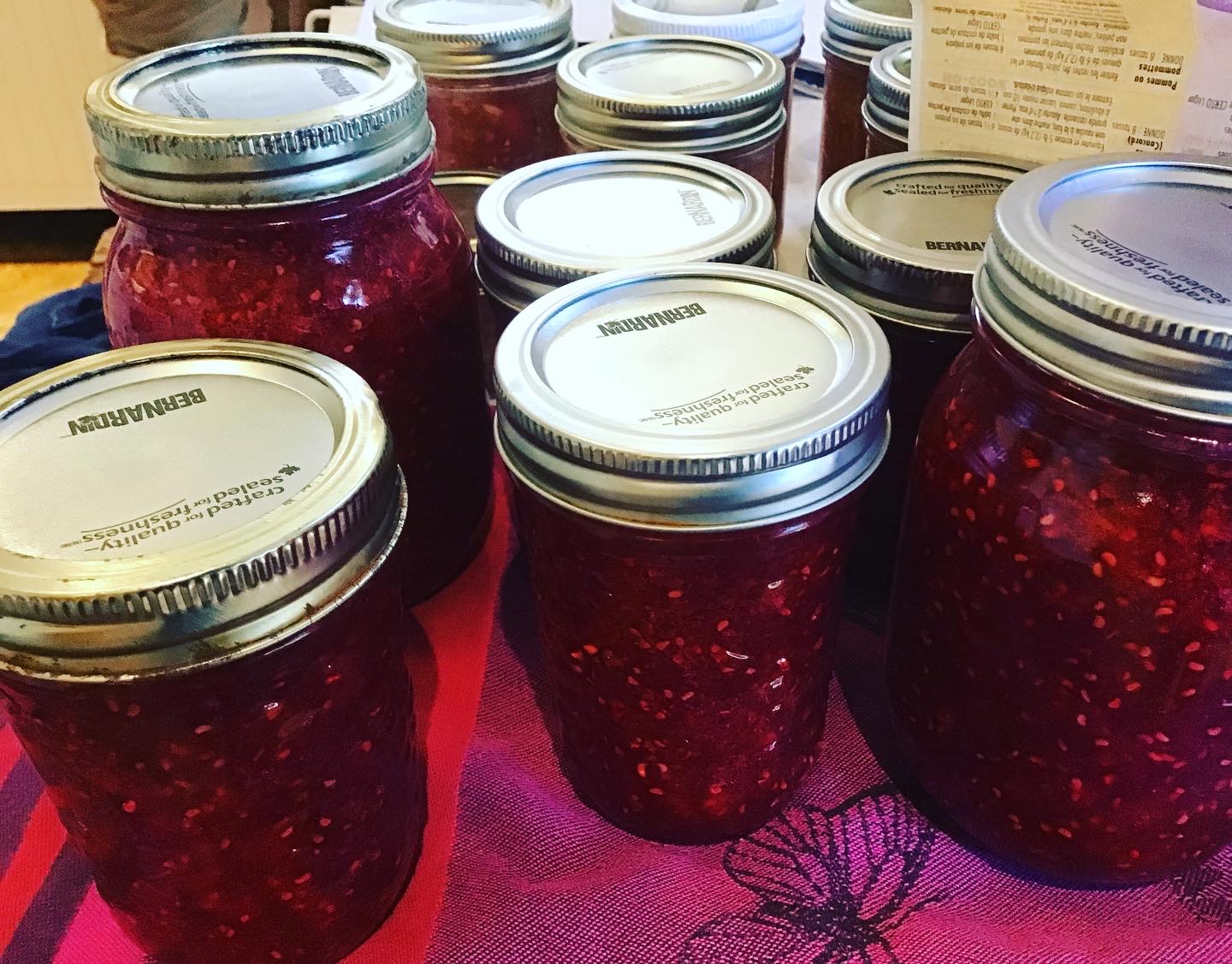
I've canned some jam (natural outcome after all that berry picking!) and, despite our hot summer, managed to make a pie recently after a kind neighbour gifted us with an entire quart bag of pitted sour cherries.  She pitted them for us!  This, of course, is neighbourliness and treasure beyond measure in our household...local fresh fruit and the gift of her time!
The tricky bit? We love many of our longtime neighbours but the infill and a recent construction in our area - also more generally targeted as part of Winnipeg's densification efforts- has caused our house's walls to be damaged. The noise and construction is hard to live through.  We also live along a very busy road. The increased traffic that returns, post-pandemic, from the nearby restaurant patios and their drunk clientele, the high schoolers going out for lunch, increased bus traffic, etc. - it gets to be a lot of noise. 

Anyway, due to the disruptions near us and the third wave of the pandemic in Manitoba... (and likely, a fourth wave coming for those who aren't vaccinated...)
--this summer has been different than planned. Whew.  Now, the professor has a grant due, our kids are too young to get vaccinated yet, and we still can't see any of our relatives across the border.  (They're vaccinated, we're vaccinated, but the delta variant, the travelling, health issues, and kids too young to be vaccinated yet--make this too complicated at present.)
So, in the meanwhile, here are some lightweight organic crinkle cotton pants that I made!  Here are some jars of jam!
Here's to the summer that got away from me.  Now, like those GPS things in the car, we're recalibrating--and readjusting our summer route.

Labels: , , , , , , , ,

Monday, March 16, 2020

Everybody, WASH!

Nearly two weeks ago, I wrote this piece, which appeared in the Vancouver Jewish Independent newspaper on Friday:
Be sure to wash your hands 

A quick summary?  Handwashing and social distancing are ancient ways of preventing the spread of disease.  Hoarding's not new either.  You can find it all spelled out in the Torah.

That said, here is a particularly funny memory I had (and mentioned in the article) --of Sesame Street.  You can see that this skit was done long ago, when Mr. Hooper was still alive.  The news, about washing, isn't new...but this skit? Well worth seeing it again!

I hope you are healthy, washing your hands, and practicing social distancing. 
Wishing you all good things,
Joanne

Labels: , , , , , , ,

Monday, February 01, 2016

Connecting to knitters' past: A UFO tale

If you've been a knitter for any length of time, this might have happened to you... one of my husband's work colleagues is a knitter.  Her knitting friend passed away.  Friend's husband gave the Professor's colleague some knitting.  One day, the Professor speaks with her in the hall, and she asks if I might help with it.  Then, my husband -the Professor- brings home a package.

First, there were a pile of needles, which I gave to a local yarn shop so they could use it in their teaching and charity programs.  Also in the pile was this pattern, a Basketweave Jacket from an Elle magazine book publication from 1986.  In the pile of yarns were a bunch of dark gray skeins of Rowan Donegal Lambswool and some skeins of tweedy brown Rowan Fox Tweed.  Also, two fronts and one back of a vest, with the 2.5mm needles still stuck in the knitting.

Now, I wear a lot of brown and gray, but I'd not voluntarily knit with this dark gray.  It's hard to see to work with it.  Plus, unless I'm knitting socks, I'd not consider knitting anything this fine...the pattern says the gauge should be 33 stitches =4".  (That's FINE KNITTING, folks!)

However, when I looked at it, I saw I could just finish the row, cast off, sew up the seams and the vest would be nearly made.  I wouldn't make it like the 1986 vintage pattern, but I'd have a vest...to wear, if it suits, or to give away.

The task was made a bit more difficult because some of the lights in our living room were temporarily not working, it's winter time, and dark as all get out.  Plus, we had yet another virus going on, and I had a hard time concentrating while watching all those kids shows and catering to a sick 4 year old. (AGAIN.)

When I'd finished, I decided to wash it to block it, because heaven knows how long it had been sitting in that bag.  Lately, I've been washing these things in my washing machine on a cold water gentle cycle.  I have world's lowest water pressure in my washer, so all my knitted things usually turn out well...very lucky, actually.  However, this time, the vest came out having sprung a hole or two.  Turns out that Rowan Donegal Lambswool, expensive and fine yarn that it is, isn't very sturdy.  I had a panicky moment, worrying about moths, so I had the Professor inspect it.  (he studies moth genetics)  He says, nope, that is a plain old hole.  Not a moth hole.  Whew!  Luckily, it is a 'sticky' wool, so I was able to mend those 3 holes right up...then...

I dug around until I found the right button.  This button was given to me at a Manitoba Craft Council sale in November of 2010.  (I remember because I was a vendor at the sale, trying to sell handwoven rugs, newly pregnant with twins, terribly ill with morning sickness, and we had a plumbing disaster that weekend.  Oy.  How could I forget?)  Anyhow, this button is handmade by Evelin Richter, and it totally matches.  Obviously, it was waiting for this moment.

Since the pattern clearly wasn't designed for a button, I went right ahead and made another hole.  This is also called an 'afterthought buttonhole.'  Basically, you carefully cut the yarn where you want the button, unravel a bit, and then sew the heck out of the buttonhole to be sure it doesn't unravel further.  Odds are this button hole won't unravel now, or at least, not before any of those other holes unravel again...

Anyhow, bing bam boom (as all those kids' cartoons say...), here's a vest.  I haven't worn it yet, but it is really a fine piece of knitting.  I didn't know the knitter, and I certainly would not have done it myself on such skinny little needles!  Even before I had twins, I did not have patience for this kind of teeny weeny stitches in a dark color.

 However, it is well worth saving.  I'm already looking forward to how I will use the rest of the yarn leftovers (doubled, in the case of the Donegal lambswool, of course) but mostly, I feel a profound sense of connection.  Throughout history, we anonymous knitters have created all sorts of clothing and works of art...and we've left plenty of UnFinished Objects (UFOs) behind.  My mom has willingly finished things for other knitters who have passed away and therefore have not been able to it themselves...a baby blanket, a grandchild's afghan, etc.  Now, I have joined the ranks.

I hope that in that great knitting group in the cosmic beyond, somebody sees this one and smiles.  It goes without saying, too, that I hope one day someone will cherish my leftovers, and do the same for me.

Labels: , , , , , , , ,

Monday, November 16, 2009

taking the tour

Many times, I think knitting someone else's design is like taking a tour. You're exploring how someone else thinks and works, seeing what their strengths, interests, and weaknesses are, and, if you're me, analyzing how that works compared to my designs.

Part of my "move to Canada" knitting was doing just this--I decided to knit a Lady of the Lake kit by Fleece Artist, a Canadian handdyer and designer. I finished the sweater last week. The photo has a stripe of sunlight across the bottom--that's not a change in the colors of the sweater!

It fits nicely and I think the design is flattering. The way it was designed was innovative--only down side was that the pattern could have used some tech editing. I'm a stickler for the details sometimes!

This past weekend I had some knitting time while taking a bus tour of historic Jewish Winnipeg. My professor was the one signed up for the trip but he ended up on a work trip instead, so I decided to take his place. He asked me to recount the details...so I'm going to try to take everybody on a vicarious trip of some of the highlights!

Many immigrant groups moved to Winnipeg from about 1880 onwards...this was in part to escape discrimination, and in part economic. Winnipeg wanted to recruit people, and it was an affordable place to settle. The Canadian Immigration folks encouraged the move west. So, Eastern Europeans moved to the prairies. Ukrainians, Polish and German Catholic immigrants...and also, Polish, German and Russian Jews.

While the groups were encouraged to move here, there was no infrastructure in place to receive them. The Jewish community built a lot of organizations to help immigrants. They created a free health clinic called Mount Carmel Clinic to help poor people get medical care. In the 1930's, they built an old age home called the Sharon Home. This place had extension upon extension put on it, and now has finally moved to a new facility in the south of the city. Back in the old days, when a married couple couldn't keep up in their house anymore, they might sell it and "move to the Sharon Home." Today, the Sharon home is part of the Canadian health care system. A woman taking the tour with me told me about her 93 year old grandfather who announced he was ready to "move to the Sharon Home." His family had to tell him that according to health care rules today, he's not sick enough! (he's moved to some other retirement facility in town.)

There were several schools in town. This shows the hall attached to the old Peretz School. This was a left wing, Yiddish based education, the school was started in 1914. The building housed up to 400 kids. That little parking lot (without the utility equipment in it) was the playground for the whole school. The kids played baseball there on that tiny blacktop, and apparently the lady in the house next door suffered a lot of broken windows!

Every Friday night, there were concerts, competitions, poetry readings, and lectures in that hall, and several hundred people would squeeze in. These were families without TV, so they organized their own entertainment!

The Peretz kids didn't get along with the Talmud Torah kids, whose curriculum was more traditional and religious. (I didn't get a photo of the Talmud Torah buildings--none of these buildings is being used by the schools anymore these days.) This is a timeline of Winnipeg's Jewish day schools.

Most of the immigrant communities had their own lending systems. There was one bank in the North End of Winnipeg that had a Jewish assistant manager--and it was the busiest bank! Long before the days of ethnic and interest group banking, that one bank had figured out it was useful to have someone employed there from the neighborhood immigrant commmunities! The Jewish community also had a branch of the Hebrew Benevolent Society. Here's an explanation of what they did that I found here. The short version? They gave out micro loans and helped keep the poor and needy afloat.

Winnipeg’s Jewish community, although with a later start than Toronto and Montreal, developed an exceptionally broad aid network. A Hebrew Benevolent Society was established in 1886 to take over the work of earlier groups that had helped to absorb nearly 340 pogrom refugees in the city. The new organization carried out charitable programs for the next fifteen years, assisting needy local families, aiding the Jewish farm settlements, helping transient immigrants to US cities, arranging job placement for newcomers, and contributing to the Winnipeg General Hospital. In 1906 the Hebrew Sick Benefit Society was founded, with its several hundred members deriving not only the usual cemetery plots, sick benefits, and loans, but also cultural advantages such as drama and lectures. B’nai Brith, the Jewish fraternal and charitable organization, had arrived in Toronto in 1875 and Montreal in 1881, while Winnipeg Lodge No. 650 was formed in 1909 and by 1913 had over three hundred members. The lodge’s early activities included action against antisemitism, an employment bureau, and a fresh-air camp. In 1912 the lodge aided the formation of one of two Jewish orphanages that were merged a few years later, functioning as the Jewish Orphanage of Winnipeg until 1948.

Click on the photo and when you see it large, you can see the "HBS" initials in the railings. The orphanage mentioned here operated not only for orphans, but also for Jewish kids whose parents lived in rural communities. The children would live at the orphanage in town so they could get an education.

Right near there is Gunn's bakery, one of the few businesses still left from that time period. Gunn's has been operating since 1937. It bakes very good bread and creates specialities for a lot of the ethnic immigrant groups in the area. They make over 20 varieties of bread!

Throughout the north end of Winnipeg, there used to be many small synagogues. There are still a few there, but most of the congregations are now in the south end of town. This is doorway to the Ashkenazi Synagogue, the oldest existing synagogue building in Winnipeg. The congregation has been meeting in that location since 1922. There were synagogues for every political and interest group, from the Sholom Aleichem shul (communists) to the Butcher's Shul (Yes, that was for the Kosher butchers.) Here's a long list of just the synagogue cemeteries.

There are even odes and editorials to this community.

I love social history and try to find "tours" in many things I do. So, I took a tour through someone else's knitting design...and I took a more literal tour of the old neighborhoods in Winnipeg. Hope you enjoyed the excursion...
(and I hope I did a good enough job so that my professor doesn't feel he missed anything!)

Labels: , , ,

Monday, December 22, 2008

Social History #3

The professor and I saw this car one day in August, along the route we usually walk our dogs. It was gone (towed away) by the time we came back down that block. I've been waiting for a time to post this photo for a while--unfortunately, I think I've found it.
This Research Note from the National Endowment of the Arts fits perfectly with an image of an old, rusted out antique car.
Why, you ask? Well, according to this research on women artists in the United States from 1990-2005, women will have to work 25% longer to earn what male artists earn. Worse, the pay disparity becomes worse as women artists age...so the older women artists become, the less likely they'll be to catch up to male artists. Women artists will have to work until they are perhaps as beat up as this jalopy and---still don't earn what male artists earn.
If you're up on your feminist statistics, this seems like old news. In fact, the current statistic for women nationally is that women in the United States earn 77 cents for every dollar a man earns. (working full time, at comparable professions.) However, for women artists, it's 75 cents to every dollar a male artist earns. If you read the research note in detail (and I encourage that, it's not long and it's enlightening) it indicates that there are exceptions. Younger women (18-24) earn up to 95 cents for every dollar men earn, while older women earn 67 cents for every dollar men earn. The findings are not radically different when compared to other labor markets...but overall, it's bad news for women artists in the workforce.
In particular, it indicates that women artists may marry but don't have children with the frequency of the national average. I wonder, is that because it's very hard to have health insurance or provide it to your children as an artist who is self-employed? There are also interesting statistics that indicate that women earn more in Kentucky than the average--but I daresay that is because the overall average for men's salaries is lower here. State by state statistics for this can be illuminating.
What does this have to do with social history and the phrase "and she knits?" Social history often looks at the underclass...and if the research starts with 1990, we're looking at historical data from 3 to 18 years ago. Knitwear designers and writers are part of this overall labor category of "artist." Fiber artists, of course, fit in the category. Until we find a way to value women's work and women -- knitted work, written work, design work... the way we value traditionally male work and men-- women artists will be undervalued. Many talented female writers/designers/artists who do not rely on spousal support end up needing to change fields just to support themselves. Alas, even 2 cents on the dollar makes a big difference.
What a miracle it would be if women in the United States earned equal wages for equal work. That's part of this mystical thing that we call equality, part of the parity refered to by feminists like me. I know that I earned more the year before marrying than I've ever earned in the ten years since--almost a penalty for wedlock...and yes, that's with two graduate degrees. (not lacking in the education or experience department...)
To read the whole report rather than just the summary above, Click here to download the pdf. (it takes a bit to download--warranted, given the weighty topic.)
So, don't like being compared to a Tin Lizzie? What do you think about the NEA's research note? What are good solutions?

Labels: , , , , ,

Tuesday, December 09, 2008

social history bio #2-Jerilea Zempel

I'm going to take a wild guess here and ponder some possibilities about my last post:
a) many people lack a fast enough connection to watch a video
b) folks don't like watching video clips, even on topics they enjoy? (like knitting)
c) it didn't seem interesting or like legitimate information
d) it didn't seem relevant to the topic/it was too radical/controversial/fill in the blank
e) too busy with pre-holiday shopping? (this is my husband, the professor's contribution)
f) don't like Stephen Colbert/Comedy Central?
g) all of the above?

You're welcome to vote on this in the comments...
I'm still enchanted by this Comedy Central clip and was struck by the lack of interest!

In the meanwhile, here's more information about why I posted that video clip:
Jerilea Zempel is an artist and professor at Fordham University. Her work has won NEA grants, been exhibited in the US and Europe, and she's taught at Bennington, Barnard, Rhode Island School of Design and the Maryland Institute College of Art. I found this out via a bio posted about her 2oo9 residency here.

Professor Zempel's border crossing experience (from Canada to the U.S.) is written up in detail on her blog (listed above), newspaper articles, as well as on the following other sites: Dream Activist, Don't Doodle in your Notebook

Why did I include this in the feminist social history/bio series, "And she knits?"
1) This is an artist whose work comments on aspects of our daily lives
2) Her work intersects poignantly with typical history topics of war, peace and geographic boundaries.
3) It fits into a definition of social history "that is often described as history from below or Grass-roots history because it deals with the every-day people, the masses and how they shape History rather than the leaders." (One could argue that educators are leaders, but women educators might still be considered more grass-roots in this definition.)
4) Oh...and here's the big one. This artist uses knitting and crochet as her mediums (media?) to get her point across. That's very cool, in my book. It also fits perfectly into this phrase...."and she knits."

You'll note that there's no photo posted here...I didn't want to steal any of this American artist's work without permission, since the border patrol stopped her because they feared "some kind of copyright infringement" when they saw her sketch book and yarn/crochet hooks!

Labels: , , , ,

Sunday, December 07, 2008

radical knitting

Yup, it's what we (fiber) artists do. We run around, "arting" it up, crossing borders and causing mayhem.

What, you say? This isn't Joanne's normal blog post...no bread baking or dog photos accompanying the knitting?

This is my "social history/bio #2" post. My friend Cindy sent me this link. I realize this is more like recent history, but sure is worth checking out. Enjoy this video clip called "Nailed 'Em-Radical Knitting" and just think of me, crossing the border to Canada next summer. Will the border control folk get suspicious when my landing documents mention "50+ lbs of wool roving, used as a packing material?"

EDIT (12/8/08): Note, the below video I posted yesterday is funny and worth watching. It is NOT about illegal immigration. It's about an American artist who uses knitting and crochet to do art and political commentary. It's about her experience with crossing the border entirely legally. I have plenty of choice thoughts on immigration (how did most Americans get here? Oh, and if the immigration regulations were as difficult then as they are now, do you think your family would be here?) however, I didn't bring those up when posted this... this video doesn't either. Many millions of border crossings are entirely legal. Enjoy it. Have a good laugh.


Psst. Drop me a line down here. Tell me if you laughed. (I did) Also, do you think it's fair to call recent border patrol activities "recent history?!" Any other knitting topics or people you'd like to see me cover in my social history/bio posts?

Labels: , ,

Friday, December 05, 2008

hibernation

Every year, about this time, I begin what the professor calls my "hibernation." This comprises of a great deal of sleeping, knitting, nesting, and coping with the urge to eat large quantities of homemade, warming foods. (think roasts, stews, baked goods, and uhh, more homemade baked goods.)

Anyway, as the hibernation came on this year, I thought-gee, I feel out of whack. Even though that was entirely legitimate (busy work schedule, sick nephew, overall doom and gloom in the world) I did something relatively clever. I got myself to the doctor to get my thyroid levels checked. "Ah hah!" Guess what? The hibernation is probably caused by my increasingly underactive thyroid. No big deal. Just take a little more medicine in the morning and --hopefully, I'll be better and more active in no time. In the meanwhile, I've been feeling just like Sally looks in this photo. Plum tuckered out!

There is big news this week to report.
#1) It appears that my social history idea, preferably to do with knitting, is a popular hit! I already have an idea for post number 2, and I'll try to keep that up, off and on, over the next few weeks.

#2) Yesterday, my kind editors for book #2 said, "It's time! Start sending your knitted samples to us for tech editing and photography!" I gulped. I said ok. Before I knew it, I'd packaged up roughly 11 designs (but in multiple sizes, variations, etc...so a lot more knitting than that) and Fed Ex'ed them off to the right folk. Now, counting some earlier designs that I'd sent off, I've got roughly 15 of my designs away from home, all worked up since this spring. I got home. I felt completely wiped out. Emotionally exhausted. That's when I realized something.

For Fiber Gathering, my husband, the professor, was the photographer. I didn't have to mail any of my designs (or any of the other designers' projects--they all came to me) away for photography, and my tech editor consulted the photos, for the most part, and only referred to the actual garments when absolutely necessary. Sure, I've sent away finished designs to magazines, yarn companies, and books before. Sure. One or two at a time. This was like sending away 6-9 months of my life! I hope they get to the editors safely.

#3) My nephew is making good progress. He's still in intensive care, with no date to come home in sight, but things are looking much more hopeful. There might even be a bris, which is heartening news. (This is always delayed when a baby boy is too sick to have one.)

#4) You'll note in these funny photos I caught in my office that Harry-the furry dog- is edging ever closer to Sally on the couch. Apparently true togetherness only takes place in the dog world after roughly 3 years of living together....or, in human years, when dogs are in their late 20's to early 30's?! (Harry and Sally were both 6 months to a year old when we adopted them from animal shelters in 2004 and 2005.) Or, as my biology professor says...maybe they're just huddling up because they're cold. Yeah, probably, but I like my theory better!
Are you hibernating? Feel bereft when you send off your knitting? How about your dogs? Do they cuddle up just for warmth or affection, too?

Labels: , , , ,

  • Check out my website here: www.joanneseiff.com
  • Sheep to Shawl
  • Dances with Wool
  • Carpe Diem!
  • Knitting Along the River
  • Getting Stitched on the Farm
  • Modeknit/Knitting Heretic
  • Pleasant & Delightful
  • Catena
  • Independent Stitch
  • Rosemary-go-round
  • Spin Dye Knit
  • Kentucky Arts Council
    In 2007, Joanne Seiff was awarded an Al Smith Fellowship in recognition of artistic excellence for professional artists in Kentucky through the Kentucky Arts Council, a state agency in the Commerce Cabinet, supported by state tax dollars and federal funding from the National Endowment for the Arts, which believes that a great nation deserves great art.

    Powered by Blogger